Thursday, September 18, 2008
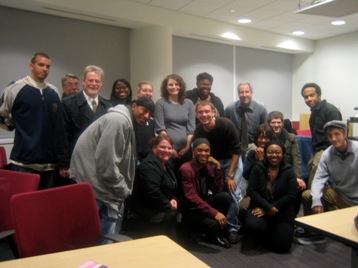
UCABJ Adviser Featured in Local Publication
Elissa Sonnenberg, assistant director of UC's journalism program and UCABJ faculty adviser, is featured in CityBeat's annual Cool Issue. In case you didn't know, she's awesome.

An Invitation to Young Journalists
A message from Columbia Journalism Review:
Back in June, we gave one of our interns here at Columbia Journalism Review the daunting task of tracking newspaper buyouts and layoffs since 2007. She diligently worked the press clips and the phone and counted up to 2,700 by the end of the summer. The spreadsheet is not definitive but it is depressing—statistics from a plague (three here, twenty there; eighty here, 150 there) that is moving through newsrooms across the country. Yet at the same time, a world of news innovation is emerging online, both inside and outside of mainstream media. A recession looms like an iceberg but under the waterline is something unknown, a great restructuring of the way people get their news and information. The recession will end, but the fate of quality journalism is not easily discernable. Here at CJR, we intend to do all we can to shed light on that future and to explore the efforts under way to repair or replace the economic model. And also to give voice to those affected.
In July, we invited laid-off and bought-out journalists to reflect on their experience in the form of a letter to colleagues. We published a number of them on our Web site under the rubric Parting Thoughts, at cjr.org/parting_thoughts/, and will continue to do so as they arrive. Now we are issuing a similar invitation to the young people who’ve come into the profession in the last five years or so, and the young journalism students who soon will. We invite them to air their concerns and hopes about journalism, too. The central questions: What do you see in this business that makes you still want to pursue it? How do you imagine people will get quality news five years down the road? How will you try to fit in?
We’ll call this one Starting Thoughts, and if you fit the category (or know young reporters or journalism students who do), we invite you to join the discussion by emailing us at editors@cjr.org. We’re looking for anything from 600 to 1,200 words. Please put “Starting Thoughts” in the slug line.
Regards,
The editors
Columbia Journalism Review
Back in June, we gave one of our interns here at Columbia Journalism Review the daunting task of tracking newspaper buyouts and layoffs since 2007. She diligently worked the press clips and the phone and counted up to 2,700 by the end of the summer. The spreadsheet is not definitive but it is depressing—statistics from a plague (three here, twenty there; eighty here, 150 there) that is moving through newsrooms across the country. Yet at the same time, a world of news innovation is emerging online, both inside and outside of mainstream media. A recession looms like an iceberg but under the waterline is something unknown, a great restructuring of the way people get their news and information. The recession will end, but the fate of quality journalism is not easily discernable. Here at CJR, we intend to do all we can to shed light on that future and to explore the efforts under way to repair or replace the economic model. And also to give voice to those affected.
In July, we invited laid-off and bought-out journalists to reflect on their experience in the form of a letter to colleagues. We published a number of them on our Web site under the rubric Parting Thoughts, at cjr.org/parting_thoughts/, and will continue to do so as they arrive. Now we are issuing a similar invitation to the young people who’ve come into the profession in the last five years or so, and the young journalism students who soon will. We invite them to air their concerns and hopes about journalism, too. The central questions: What do you see in this business that makes you still want to pursue it? How do you imagine people will get quality news five years down the road? How will you try to fit in?
We’ll call this one Starting Thoughts, and if you fit the category (or know young reporters or journalism students who do), we invite you to join the discussion by emailing us at editors@cjr.org. We’re looking for anything from 600 to 1,200 words. Please put “Starting Thoughts” in the slug line.
Regards,
The editors
Columbia Journalism Review
Wednesday, September 17, 2008
I'll See Your "New Media" and Raise You "Old Media 2.0"
I think we can all agree that the problem with j-schools is most of them are late adopters of new media strategies, but this isn't an "old media vs. new media" issue. It's a "plus" issue. These days, everyone who wants to work (or continuing working) in this business should have traditional journalism skills plus a working knowledge of new media. That's why I appreciate this MediaShift post from Alfred Hermida, an assistant professor at the University of British Columbia's Graduate School of Journalism and founding news editor of the BBC News Web site. (It's somewhat of a rebuttal to this post by a NYU journalism student.) Hermida talked to leading multimedia journos and profs during the Online News Association conference and came to this conclusion:
The advice for graduates was that they need journalism plus a new set of skills. The basics of journalism — curiosity, passion, accuracy, serving the public interest — were still important. But journalist students also need to learn about how the digital revolution has changed, and continues to change, the media.
I think that's something that everyone can take to heart.
The advice for graduates was that they need journalism plus a new set of skills. The basics of journalism — curiosity, passion, accuracy, serving the public interest — were still important. But journalist students also need to learn about how the digital revolution has changed, and continues to change, the media.
I think that's something that everyone can take to heart.
Friday, September 12, 2008
UCABJer Writes About Star Wars on The Root
Our very own Geoffrey Dobbins, UCABJ vice president, appears on The Root again this month, writing about his love of Star Wars. Nice job, Geoffrey!
Thursday, September 11, 2008
Remembering, Socrates style
Suheir Hammad is a poet that I first heard about through HBO's Def Poetry
There’s …. adult language... in it. Viewer discretion is advised.
Suheir Hammad – First Writing Since
It’s that time again. Time to mark what happened on this day seven years ago on this date, when passenger planes exploded in
...and more than 30 times as many civilian lives were taken in Iraq and Afghanistan during the two wars that followed.
You know me. The way I remember what happened in my country won’t have the same kind of militarism you might see elsewhere. Why does love of country have to so narrowly revolve around weapons and bloodshed? Isn’t there a lot more to love about who we are?
Let’s remember by flexing our ability to empathize with those that, despite the supposed “clash of cultures,” are actually a lot like us. Let’s remember from the perspective of those that get the short end of the stick. Let’s remember by asking the sorts of probing questions that challenge dominant assumptions and strengthen democratic energy and would make Socrates proud. We journalists are good at that.
More great poems/videos:
More to think about:
New Yorker – Talk of the Town – September 24, 2001
(Includes Susan Sontag’s briefly famous/notorious essay)
Wednesday, September 10, 2008
Breakfast with David Gergen
Union Institute & University will host a Q&A with DAVID GERGEN, on Sunday, September 28, from 9-11 a.m. at UI&U, 440 East McMillan St., Walnut Hills.
For 30 years, Gergen has been an active participant in American national life—as a commentator, an editor, a teacher, a public servant, a best-selling author and an adviser to four presidents. He served as director of communications for President Reagan and held positions in the administrations of Presidents Nixon and Ford. In 1993, he put his country before politics when he agreed to first serve as counselor to President Clinton on both foreign policy and domestic affairs, then as special international adviser to the president and to Secretary of State Warren Christopher.
David Gergen is a professor of public service and the director of the Center for Public Leadership at the John F. Kennedy School of Government at Harvard University. He is also editor-at-large at U.S. News & World Report and is a Senior Political Analyst for CNN. Mr. Gergen also regularly serves as an analyst on radio shows, and he is a frequent lecturer at venues around the world. In the fall of 2000 he published a best-selling book titled, Eyewitness to Power: The Essence of Leadership, Nixon to Clinton.
This event is free and open to the public, however, seating is limited and priority is given to journalism and political science students, who may preregister by calling Nicole Hamilton at 513-487-1194, or by emailing at Nicole.hamilton@tui.edu. Coffee and bagels courtesy of Marx Hot Bagels.
For 30 years, Gergen has been an active participant in American national life—as a commentator, an editor, a teacher, a public servant, a best-selling author and an adviser to four presidents. He served as director of communications for President Reagan and held positions in the administrations of Presidents Nixon and Ford. In 1993, he put his country before politics when he agreed to first serve as counselor to President Clinton on both foreign policy and domestic affairs, then as special international adviser to the president and to Secretary of State Warren Christopher.
David Gergen is a professor of public service and the director of the Center for Public Leadership at the John F. Kennedy School of Government at Harvard University. He is also editor-at-large at U.S. News & World Report and is a Senior Political Analyst for CNN. Mr. Gergen also regularly serves as an analyst on radio shows, and he is a frequent lecturer at venues around the world. In the fall of 2000 he published a best-selling book titled, Eyewitness to Power: The Essence of Leadership, Nixon to Clinton.
This event is free and open to the public, however, seating is limited and priority is given to journalism and political science students, who may preregister by calling Nicole Hamilton at 513-487-1194, or by emailing at Nicole.hamilton@tui.edu. Coffee and bagels courtesy of Marx Hot Bagels.
Tuesday, September 9, 2008
To Tape or Not to Tape?
This morning on The Diane Rehm Show, Zbigniew Brzezinski, the lead foreign policy advisor during the Carter administration, questioned the accuracy of quotes from Bob Woodward's new book on the recent surge in Iraq, The War Within. He told Rehm that if Woodward's conversations hadn't been taped, any assertions that the quotes from those conversations are accurate should be called into question. I'm sure most journalists have faced these types of questions at one point or another. It reminds me of a story I read in The New York Observer a couple of years ago. Tape It, Baby, Tape It! tells how some writers, particularly magazine writers, think their note-taking skills are superior to tape recorders. Let me say flat-out that it's impossible to take better notes than a tape recorder. Impossible.
With that said, what were you taught about taping conversations during your college years? What are you being taught if you're still in school? Are there any daily reporters out there who tape? Non-daily folks, are there any instances where you wouldn't tape an interview? Memory, by nature, is faulty. What do you do to insulate yourself from claims of quote inaccuracy?
With that said, what were you taught about taping conversations during your college years? What are you being taught if you're still in school? Are there any daily reporters out there who tape? Non-daily folks, are there any instances where you wouldn't tape an interview? Memory, by nature, is faulty. What do you do to insulate yourself from claims of quote inaccuracy?
Subscribe to:
Posts (Atom)